
Our computer vision practice works with enterprise clients across manufacturing, logistics, retail, and corporate real estate. Let's have a technical conversation.
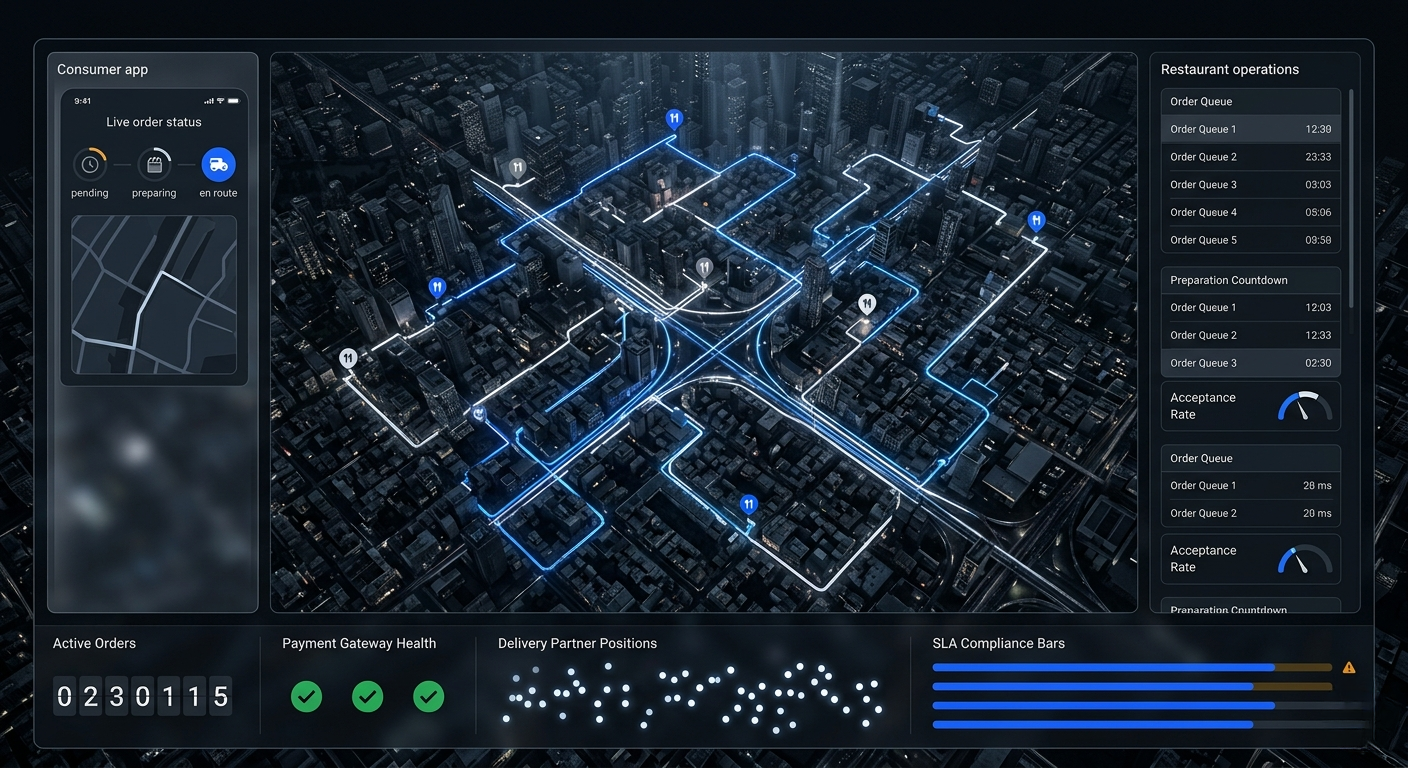
A fully owned, three-sided food delivery marketplace — built from the ground up for enterprise scale, designed to replace third-party dependency with a proprietary platform that puts commercial control back in the operator’s hands.
For enterprise operators in the food and beverage sector — restaurant groups, retail conglomerates with F&B portfolios, regional hospitality chains, or dark kitchen operators — dependency on third-party delivery platforms carries a compounding commercial cost. Commission structures of 25–35% per order, zero ownership of customer data, algorithmic visibility controlled by the platform, and no ability to differentiate the ordering experience combine to erode margin and brand equity simultaneously. The client needed to own their delivery channel entirely: the platform, the data, the customer relationship, and the commercial terms with restaurant and delivery partners.
Zest Synergies designed and delivered a complete three-sided marketplace platform — every surface of it custom-built, none of it white-labelled SaaS. The consumer-facing app provides a full ordering experience with real-time tracking and personalisation capability. The restaurant portal gives kitchen and management teams live order visibility, menu management, and performance analytics. The delivery partner app handles assignment, routing, proof-of-delivery, and earnings management. A centralised operations dashboard ties all three together for the platform operator, providing live command-and-control visibility across the entire network.
A 15-million-user capacity ceiling was established at the outset as a non-negotiable architecture requirement — not a future aspiration. The infrastructure was designed and stress-tested to sustain peak concurrent order volumes from day one, with horizontal scaling built into every layer of the stack. The platform launched into a competitive market and sustained traffic spikes during promotional periods without degradation in tracking accuracy, payment processing reliability, or order routing performance.
Building a marketplace platform at this scale is an exercise in simultaneous product engineering across three distinct user experiences, each with its own performance requirements, failure modes, and commercial logic — all of which must remain coherent in real time as thousands of concurrent transactions move through the system.
The customer-facing app was built for conversion and retention at scale. Core capabilities include geo-aware restaurant discovery, real-time menu availability reflecting live POS data, order customisation, saved preferences, loyalty programme integration, and a live tracking experience with sub-minute ETA refresh. Personalisation logic surfaces relevant restaurants and promotions based on order history and location context. The app was built for both iOS and Android with a shared business logic layer to maintain feature parity across platforms.
Restaurant partners access a dedicated portal for menu management, order acceptance, preparation time configuration, and performance reporting. Direct POS integration enables automatic menu synchronisation and order injection into the kitchen display system — eliminating the tablet-per-platform problem that fragments operations in multi-platform restaurant environments. Restaurant operators see a single source of truth for all orders regardless of originating channel.
The delivery partner app handles the full rider workflow: order assignment with intelligent proximity and capacity logic, turn-by-turn navigation with live traffic routing, multi-order batching support, proof-of-delivery capture, and an earnings and payout dashboard. Assignment logic optimises for ETA accuracy rather than simple proximity, accounting for preparation time estimates from the restaurant and real-time traffic conditions simultaneously.
The routing layer processes GPS data from delivery partners, preparation status signals from restaurant POS systems, and live traffic data to generate and continuously update ETA estimates throughout the order lifecycle. Routing decisions are recalculated dynamically as conditions change — not set at assignment and left static. The engine supports multi-order batching optimisation, reducing dead kilometres for delivery partners while maintaining per-order SLA commitments.
The payment layer supports simultaneous integration with eight payment gateways, enabling local payment method coverage across all operating geographies — cards, wallets, bank transfers, and cash-on-delivery flows — with automatic failover routing if a gateway experiences degraded performance. Payout orchestration for restaurant and delivery partner settlements runs on a configurable cycle with automated reconciliation against order records.
The platform operator’s dashboard provides real-time visibility across the entire marketplace: live order status, delivery partner positions, restaurant acceptance rates, SLA performance by zone, payment processing health, and customer service escalation queues. Incident management workflows allow operations teams to intervene in real time — re-routing stuck orders, issuing compensations, or flagging restaurant or partner performance issues — without requiring engineering involvement.
Smart contract risk is addressed at every stage of the process. Contract logic is designed against a defined threat model — not assembled from templates — and reviewed for known vulnerability classes prior to testnet deployment. We run a structured internal security review process and can coordinate with third-party audit firms where the client's governance requirements or regulatory environment demands an independent audit opinion. Mainnet deployment follows a controlled, staged release rather than a single go-live event.
Private key management is structured around institutional custody principles: multi-signature authorisation requirements, hardware security module integration for key storage, and segregated wallet structures that limit blast radius in any compromise scenario. Key recovery and revocation procedures are documented and tested as part of the deployment process. No single individual — including Zest engineers — holds unilateral access to client treasury positions post-handover.
The ERP–blockchain integration layer handles this bidirectionally. Token issuance, distribution, and redemption events trigger automatic updates in your ERP — balance positions, transaction records, and reconciliation data flow into your existing financial workflows without requiring finance teams to interact with blockchain tools directly. The integration is built to your ERP's API specification and tested against your specific chart of accounts and reporting structure.
Regulatory exposure depends on token classification in each relevant jurisdiction — utility token structures carry different obligations than security token frameworks. We work with the client and, where required, external legal counsel to establish the appropriate classification and structure the token mechanics accordingly. The compliance configuration layer then enforces jurisdiction-specific rules — transfer restrictions, KYC gates, holding period logic — at the infrastructure level, supporting both internal governance and external regulatory reporting.
Core ERC-20 logic on-chain is immutable by design — this is a feature, not a limitation, as it provides the auditability and tamper-proof record that institutional issuance requires. However, the contract is designed with a governance framework that allows specific operational parameters — transfer permissions, pause state, authorised minting roles — to be updated through defined multi-signature governance transactions. Material changes to token economics require a new contract deployment with a formal migration process.
Post-deployment support covers three areas: smart contract monitoring and incident response, integration layer maintenance as ERP configurations evolve, and compliance configuration updates as regulatory requirements change. We provide a retained support structure with defined SLAs for critical incidents — smart contract anomalies, custody events, ERP sync failures — and a regular review cadence for compliance and governance configuration.

A lean, senior-only enterprise technology partner specialising in AI, iPaaS, and workflow automation. We build production systems for businesses that cannot afford failure.
sales@zestsynergies.com
Copyright © 2026 All Rights Reserved.