
Our computer vision practice works with enterprise clients across manufacturing, logistics, retail, and corporate real estate. Let's have a technical conversation.
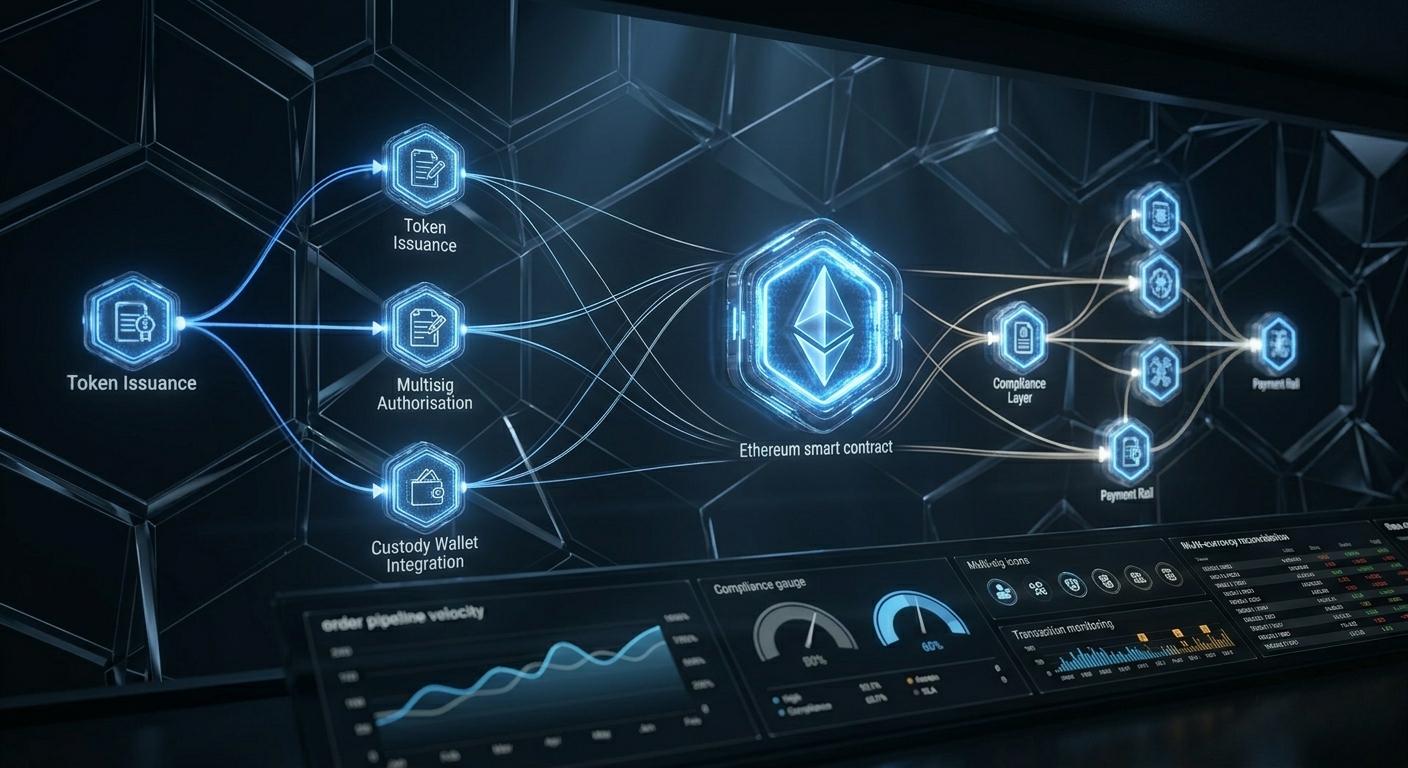
A production-grade digital asset infrastructure enabling enterprise token issuance, custody management, and ERP-to-blockchain synchronisation — built for regulated environments, governed for institutional accountability.
Enterprises entering the digital asset space face a challenge that is fundamentally different from consumer crypto adoption: they are not speculating on tokens — they are issuing them, managing them, and integrating them into existing financial and operational infrastructure. That requires a level of engineering rigour, regulatory awareness, and enterprise systems integration that no off-the-shelf blockchain tool provides. The client needed to issue a utility token on Ethereum, connect it to their existing ERP and financial systems, and do so in a way that satisfied internal governance, external compliance obligations, and institutional custody standards — all without exposing the organisation to smart contract risk or operational vulnerability.
Zest Synergies designed and delivered a complete digital asset infrastructure layer — from smart contract architecture and security audit preparation, through to custody wallet management, ERP integration, and a compliance reporting framework. The engagement covered the full token lifecycle: initial contract design and fixed-supply issuance logic, testnet validation, a controlled mainnet deployment process, and the ongoing operational infrastructure needed to manage token distribution, redemption, and balance reconciliation against the client’s enterprise systems of record.
The platform’s defining characteristic is the depth of its integration with the client’s existing enterprise infrastructure. Token issuance events, distribution transactions, redemption workflows, and balance positions are synchronised in real time with the client’s ERP — meaning finance teams work with familiar systems and familiar data, not blockchain explorers and wallet addresses. The blockchain layer is the source of immutable truth; the enterprise layer is where that truth is consumed and acted upon.
Every architectural decision in this engagement was made with institutional accountability in mind. Smart contract logic was designed to be auditable and upgradeable within defined governance bounds. Custody architecture was structured to eliminate single-point-of-failure risk. Compliance obligations were addressed as a first-class engineering requirement, not a post-deployment consideration.
The ERC-20 token contract was designed from first principles to meet the client’s specific issuance requirements: fixed supply cap, controlled minting authority, role-based transfer permissions, and pausability for emergency governance scenarios. Contract logic was reviewed against known vulnerability patterns — reentrancy, integer overflow, access control gaps — prior to testnet deployment. The mainnet deployment followed a structured release process with defined rollback contingencies at each stage.
A formal deployment pipeline was established covering Ethereum testnet validation, internal UAT against ERP integration scenarios, external security review, and a staged mainnet release with transaction volume caps during the initial operational period. This pipeline eliminated the binary risk of a direct-to-mainnet launch and provided documented evidence of due diligence for regulatory and governance purposes.
A custom integration layer connects on-chain token events — issuance, transfers, redemptions, burns — to the client’s ERP in real time. Token positions are reflected in the general ledger, distribution records are automatically reconciled against on-chain transaction data, and exception alerts are raised when discrepancies exceed defined thresholds. Finance teams interact with the token economy through their existing workflows, with blockchain complexity abstracted entirely.
Token custody is managed through an institutional wallet architecture with multi-signature authorisation requirements for high-value transactions, hardware security module (HSM) integration for key management, and segregated wallet structures for treasury, operations, and distribution pools. No single individual or system has unilateral access to token treasury positions.
An ML-based monitoring layer analyses transaction patterns in real time, flagging anomalous activity — unusual distribution volumes, unexpected wallet interactions, velocity breaches — for compliance review. The monitoring output feeds directly into the client’s AML reporting workflow, supporting regulatory obligations without requiring manual blockchain data analysis.
Token classification, reporting obligations, and transfer restriction logic vary significantly across jurisdictions. The compliance configuration layer allows jurisdiction-specific rules — transfer whitelist requirements, holding period restrictions, KYC gate enforcement — to be applied at the contract interaction layer without modifying core contract logic, maintaining a clean separation between business rules and on-chain code.
Smart contract risk is addressed at every stage of the process. Contract logic is designed against a defined threat model — not assembled from templates — and reviewed for known vulnerability classes prior to testnet deployment. We run a structured internal security review process and can coordinate with third-party audit firms where the client's governance requirements or regulatory environment demands an independent audit opinion. Mainnet deployment follows a controlled, staged release rather than a single go-live event.
Private key management is structured around institutional custody principles: multi-signature authorisation requirements, hardware security module integration for key storage, and segregated wallet structures that limit blast radius in any compromise scenario. Key recovery and revocation procedures are documented and tested as part of the deployment process. No single individual — including Zest engineers — holds unilateral access to client treasury positions post-handover.
The ERP–blockchain integration layer handles this bidirectionally. Token issuance, distribution, and redemption events trigger automatic updates in your ERP — balance positions, transaction records, and reconciliation data flow into your existing financial workflows without requiring finance teams to interact with blockchain tools directly. The integration is built to your ERP's API specification and tested against your specific chart of accounts and reporting structure.
Regulatory exposure depends on token classification in each relevant jurisdiction — utility token structures carry different obligations than security token frameworks. We work with the client and, where required, external legal counsel to establish the appropriate classification and structure the token mechanics accordingly. The compliance configuration layer then enforces jurisdiction-specific rules — transfer restrictions, KYC gates, holding period logic — at the infrastructure level, supporting both internal governance and external regulatory reporting.
Core ERC-20 logic on-chain is immutable by design — this is a feature, not a limitation, as it provides the auditability and tamper-proof record that institutional issuance requires. However, the contract is designed with a governance framework that allows specific operational parameters — transfer permissions, pause state, authorised minting roles — to be updated through defined multi-signature governance transactions. Material changes to token economics require a new contract deployment with a formal migration process.
Post-deployment support covers three areas: smart contract monitoring and incident response, integration layer maintenance as ERP configurations evolve, and compliance configuration updates as regulatory requirements change. We provide a retained support structure with defined SLAs for critical incidents — smart contract anomalies, custody events, ERP sync failures — and a regular review cadence for compliance and governance configuration.

A lean, senior-only enterprise technology partner specialising in AI, iPaaS, and workflow automation. We build production systems for businesses that cannot afford failure.
sales@zestsynergies.com
Copyright © 2026 All Rights Reserved.