
Our computer vision practice works with enterprise clients across manufacturing, logistics, retail, and corporate real estate. Let's have a technical conversation.
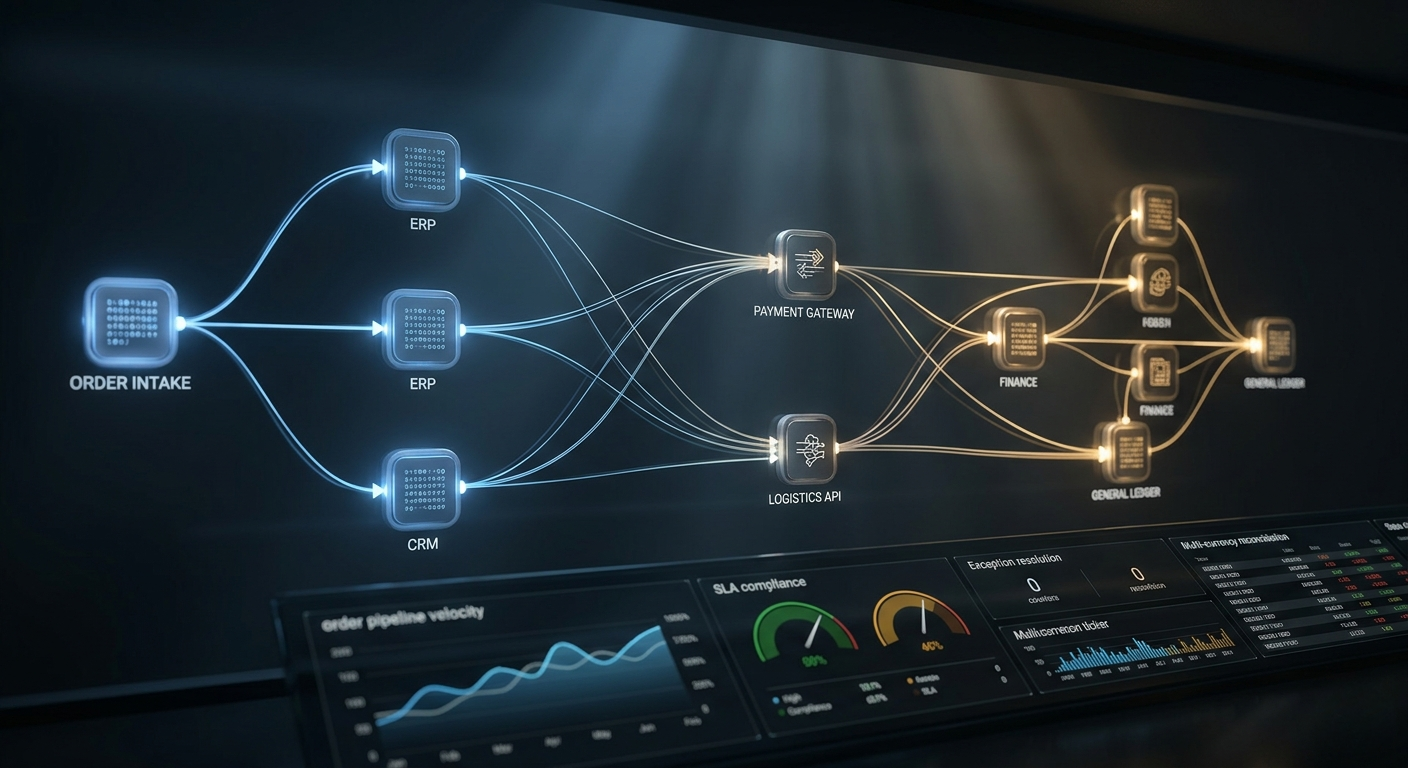
A purpose-built AI integration layer that automates the entire order-to-cash lifecycle — from order capture to revenue recognition — across ERP, CRM, payment infrastructure, and logistics networks, with multi-country compliance governance built in.
For mid-to-large enterprises operating across multiple geographies, the order-to-cash process is rarely a single workflow — it is a fragmented chain of handoffs between sales, finance, fulfilment, and customer service, each operating on different systems with different data models and different definitions of what “complete” looks like. The consequences are material: delayed revenue recognition, manual reconciliation overhead, SLA breaches that damage customer relationships, and compliance exposure across tax jurisdictions. The client needed the entire cycle automated, connected, and auditable — without replacing the core systems already in place.
Zest Synergies designed and delivered an intelligent orchestration layer that sits across the client’s existing ERP, CRM, payment gateways, and logistics partner APIs — connecting them into a single, governed workflow engine. Rather than ripping out incumbent systems, the platform integrates with them, establishing real-time data flows, enforcing business rules at each transition point, and handling exceptions autonomously where resolution logic can be defined, or routing them to the right human with full context where it cannot.
The client’s order-to-cash cycle went from a partially manual, multi-day process with frequent exception queues to a largely automated pipeline with same-day processing for standard orders and measurable reductions in DSO, reconciliation overhead, and compliance risk. Finance teams gained real-time visibility into order status and revenue position. Customer service teams gained a single source of truth for order queries. Operations leads gained SLA performance data they had never had before.
The platform was not built to automate tasks in isolation. It was architected to own the entire process — from the moment an order is placed to the moment cash is recognised — with AI applied specifically where variability, ambiguity, and exception volume would otherwise require human intervention at scale.
The platform establishes persistent, event-driven integration between the client’s ERP and CRM, ensuring order data, customer records, pricing configurations, and fulfilment status are propagated in real time across both systems. No batch syncs, no overnight jobs, no manual reconciliation between sales and finance data.
Not all exceptions are equal. The platform’s exception management engine uses ML-based classification to triage order issues — mismatched pricing, inventory shortfalls, payment failures, address validation errors — routing each to the appropriate resolution path. High-confidence resolutions are handled automatically; edge cases are escalated to the relevant team with pre-populated context and recommended actions.
For enterprises operating across tax jurisdictions, the platform embeds a configurable compliance layer that handles VAT/GST calculation, e-invoicing format requirements, and jurisdiction-specific reporting obligations at the point of transaction. Compliance logic is maintained centrally and applied consistently across all order flows, regardless of originating system or channel.
The platform integrates with the client’s payment gateways and banking infrastructure to automate payment matching, flag discrepancies, and push reconciled data directly to the general ledger. Multi-currency support and FX handling are built into the reconciliation workflow.
Fulfilment events from third-party logistics partners — despatch confirmations, tracking updates, proof-of-delivery — are pulled into the orchestration layer in real time, triggering downstream actions: customer notifications, invoice generation, SLA clock management, and returns initiation where applicable.
Every order moves through the pipeline against defined SLA commitments. The platform monitors progress continuously, using predictive logic to identify orders at risk of breach before they breach — giving operations teams time to intervene rather than simply a record of what went wrong.
No. The orchestration layer is designed to integrate with your incumbent systems — not replace them. We work with the APIs, webhooks, and data models your ERP and CRM already expose, building the intelligence and connectivity layer on top. Your existing vendor relationships and configurations remain intact.
The exception classification model is trained on your historical order data and exception patterns during the build phase. For genuinely novel exceptions — those outside the confidence threshold of the model — the platform routes to a human review queue with full order context surfaced. Every human resolution decision is fed back into the model, improving classification accuracy over time.
The compliance engine is built on a configurable rules layer, not hardcoded logic. Tax rate updates, new e-invoicing mandates, and jurisdiction-specific changes are applied through configuration rather than code releases. We provide a managed compliance update service as part of the post-deployment support structure.
The platform includes a role-based executive dashboard providing real-time visibility into order pipeline status, cash conversion cycle metrics, SLA performance by region and channel, exception queue volumes, and reconciliation status. Data can be exported or pushed to your existing BI tooling via API.
For an engagement of this scope — multiple core systems, multi-region compliance, and AI exception handling — the typical timeline is six to nine months from scoping to go-live. The process follows a phased approach: discovery and integration mapping, core workflow build and system connections, compliance configuration and UAT, and phased go-live by process area. We provide a dedicated integration architect and project lead throughout.
The orchestration layer processes and routes data between your systems; it does not create a new persistent data store by default. Where event logs and audit trails are retained — for compliance and exception traceability — these are hosted in your own cloud environment or a dedicated tenant with explicit data residency controls. Zest engineers operate under NDA and formal data handling agreements as standard.

A lean, senior-only enterprise technology partner specialising in AI, iPaaS, and workflow automation. We build production systems for businesses that cannot afford failure.
sales@zestsynergies.com
Copyright © 2026 All Rights Reserved.