
Our computer vision practice works with enterprise clients across manufacturing, logistics, retail, and corporate real estate. Let's have a technical conversation.
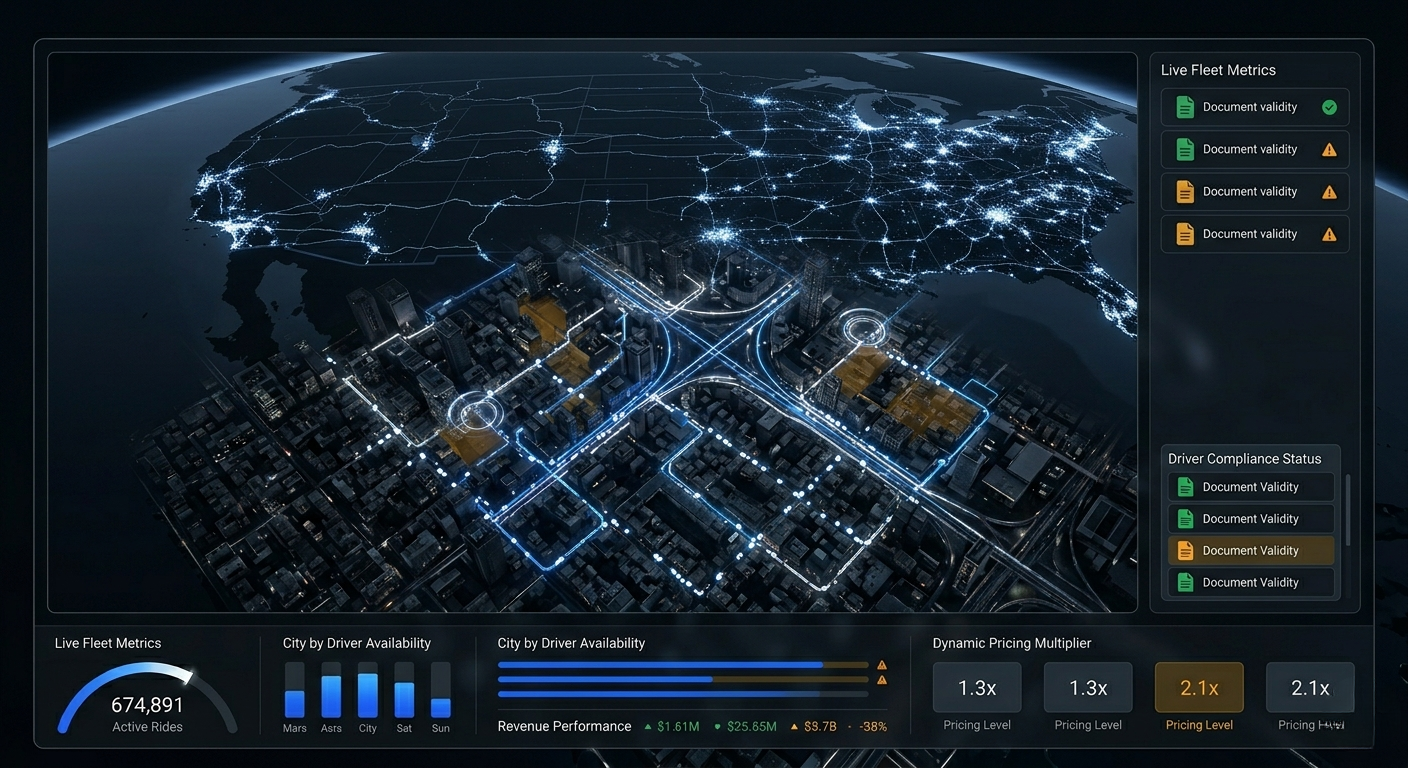
A fully owned, nationally deployed ride-hailing platform — covering real-time GPS dispatch, AI-powered dynamic pricing, driver lifecycle management, and multi-currency payments — built for the operational complexity of a multi-jurisdiction transport network at country scale.
National transport operators, government mobility agencies, and large conglomerates entering the ride-hailing sector face a choice with long-term commercial and strategic consequences: licence an existing platform and operate permanently within someone else’s infrastructure and commercial terms, or build a sovereign platform that the organisation owns entirely. The first path is faster but creates lasting dependency — on pricing models, feature roadmaps, data access policies, and revenue share structures set by the platform owner. The second path requires genuine engineering capability and a delivery partner with experience building at national scale. The client chose ownership.
The specific challenge was not simply building a ride-hailing app — it was building the infrastructure to operate a ride-hailing network across multiple cities, each with its own regulatory environment, fare structure requirements, demand patterns, and driver supply dynamics, from a single unified platform with centralised governance and local operational flexibility.
Zest Synergies designed and delivered a complete national ride-hailing platform spanning every layer of the operational stack: the passenger-facing booking app, the driver app with real-time dispatch and navigation, the operations and dispatch control centre, the driver onboarding and compliance management system, the dynamic pricing engine, and the payment and settlement infrastructure. The platform was architected from the outset for nationwide deployment — not a single-city MVP that would require re-engineering to scale — with city-level configuration independence built into the data model and operational workflows from day one.
The platform launched with a structured city-by-city rollout, allowing each market to go live with its own fare parameters, vehicle category configurations, regulatory compliance rules, and driver onboarding requirements, while feeding into a single national operations dashboard and unified analytics layer. The deployment model allowed the client to build operational capability city by city without sacrificing central visibility or governance.
Building ride-hailing infrastructure at national scale is categorically different from building a city-level pilot. The matching engine must sustain performance across thousands of simultaneous rides in multiple geographic zones. The pricing engine must balance revenue optimisation against regulatory fare caps and rider sensitivity across different markets. The driver supply system must manage onboarding, compliance, and earnings across a workforce that may number in the tens of thousands. Every architectural decision carries consequences at scale.
The dispatch layer processes live GPS positions, availability status, and ride request events to generate optimal driver assignments in under a second — across all active city zones simultaneously. Matching logic accounts for proximity, traffic conditions, vehicle category requirements, driver acceptance rates, and zone-level demand distribution. The engine rebalances continuously as conditions change, without manual dispatch intervention.
The pricing engine uses demand forecasting models trained on historical ride volume, time-of-day patterns, weather correlation, and event data to anticipate supply-demand imbalances before they manifest as service degradation. Surge pricing is triggered algorithmically, within configurable governance bounds — maximum multiplier caps, minimum activation thresholds, and jurisdiction-specific fare floor and ceiling rules — ensuring the pricing model serves both revenue optimisation and regulatory compliance simultaneously. Pricing parameters are configurable independently per city zone without requiring code changes.
The driver-facing infrastructure extends beyond the dispatch app. A structured onboarding system handles document submission, identity verification, vehicle inspection records, licensing compliance checks, and background screening workflows — with status tracking and automated rejection or approval routing. Driver accounts carry a full compliance record that updates throughout the driver lifecycle, flagging expiring documents, failed inspections, or regulatory status changes before they create operational or legal exposure.
The payment layer supports multi-currency fare collection, local payment method integration, and automated driver earnings calculation and settlement. Fare splitting, promotional code redemption, corporate account billing, and cash reconciliation workflows are all handled within the payment module. Driver payouts are processed on a configurable settlement cycle with automated earnings statements and dispute management capability.
Operating across multiple cities and regulatory environments requires the platform to apply different rules in different contexts — fare band regulations, vehicle category licensing requirements, mandatory insurance documentation, and jurisdiction-specific reporting obligations. The compliance configuration layer allows each city’s regulatory parameters to be maintained centrally and applied consistently at the operational layer, without the risk of configuration drift that comes with managing city operations in isolation.
The national operations centre dashboard gives platform management teams real-time visibility across the entire network: live fleet positions by city, ride completion rates, driver availability by zone, revenue performance against targets, customer satisfaction scores, and incident management queues. City-level operations teams access a scoped view of their own zone while central teams see the full national picture. Analytics reporting covers operational, commercial, and compliance dimensions with exportable data for regulatory reporting purposes.
Licensing an existing platform gives you speed to market in exchange for permanent commercial dependency. Revenue share structures, feature roadmap control, data ownership, and the ability to adapt the platform to local regulatory requirements are all governed by the licensor — not by you. For a national operator or government-backed mobility programme, that dependency carries both commercial and strategic risk. A proprietary platform means the fare structure, driver terms, pricing model, and customer data are entirely within your control. The economics of ownership become compelling at meaningful ride volumes, and the strategic value of owning national mobility infrastructure is not reducible to unit economics alone.
Each city or jurisdiction operates with its own configuration set within the platform — fare bands, vehicle category rules, licensing requirements, mandatory insurance documentation standards, and reporting obligations are all maintained as configurable parameters rather than hardcoded logic. When regulations change in a specific jurisdiction, the compliance configuration is updated centrally without requiring a code release or creating inconsistency across other markets. The platform is designed to absorb regulatory complexity as a configuration challenge, not an engineering problem.
The driver onboarding and compliance management system maintains a live compliance record for every driver on the platform — covering identity verification, vehicle documentation, licensing status, insurance validity, and any jurisdiction-specific certifications. Automated alerts flag expiring or lapsing compliance records before they create operational exposure. Drivers with compliance issues are automatically restricted from receiving ride assignments until resolution is confirmed. The system scales to tens of thousands of active drivers without requiring proportional growth in compliance operations headcount.
The pricing engine operates within a governance framework that you define — maximum surge multipliers, minimum activation demand thresholds, and hard fare floor and ceiling rules that reflect regulatory requirements in each jurisdiction. Within those bounds, the AI pricing model optimises for supply-demand balance: attracting driver supply to high-demand zones during peak periods while avoiding the reputational and regulatory risk of unconstrained surge pricing. The governance parameters are fully configurable by city and time window without engineering involvement.
Yes. The platform includes a corporate account module supporting pre-approved employee travel, centralised billing, cost centre allocation, and travel policy enforcement — for example, vehicle category restrictions, journey approval workflows, and spend caps. Corporate accounts can be managed through a dedicated admin portal with monthly invoicing and exportable travel records for expense management integration.
New city activations follow a structured configuration and go-live process: regulatory parameter setup, local payment method integration where required, driver onboarding pipeline activation, and market-specific testing before commercial launch. The platform architecture supports new city additions without infrastructure changes — each new zone is a configuration event, not an engineering project. We provide a retained post-launch partnership covering platform operations, scaling events, feature development, and compliance configuration updates as the network expands.

A lean, senior-only enterprise technology partner specialising in AI, iPaaS, and workflow automation. We build production systems for businesses that cannot afford failure.
sales@zestsynergies.com
Copyright © 2026 All Rights Reserved.